
Solder in the Electronics Industry
Solder is the backbone of electronics manufacturing, creating strong electrical connections between components. Solder, typically made of tin, silver, copper and lead melts at a low temperature, bonding parts without damage. Whether in circuit board assembly, semiconductor packaging, or aerospace technology, solder ensures reliability and efficiency in electronic devices.
-
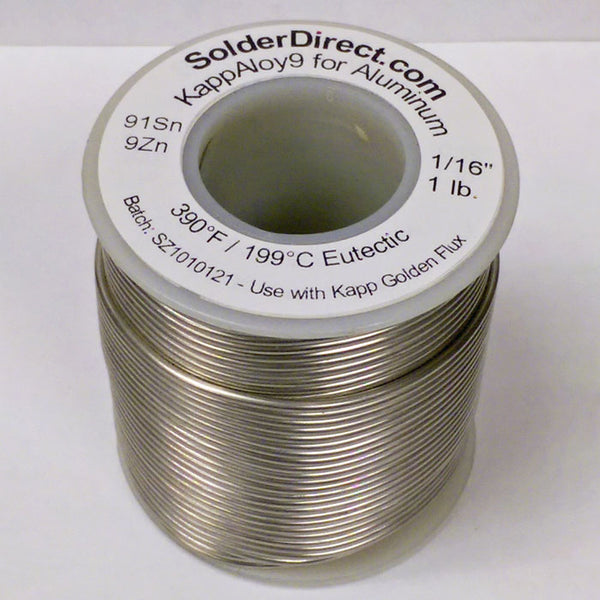
KappAloy9 - 1/16" x 1 lb spool
$58.00
91Sn/9Zn for soldering Al to Al and Cu. High strength, minimum heat (390°F / 199°C) . Solid -.062" (1.6mm) diameter x 1 lb spool. -
KappZapp3.5 Solid 1/16" x 1 lb spool
$156.00
High strength low temp NSF compliant (430°F / 221°C) 3.5% Silver solder for Copper, Brass and Stainless - Solid .062" (1.6mm) diameter x 1 lb spool.
-
KappZapp3.5A Acid Core 1/16" x 1 lb spool
$156.00
High strength low temp NSF compliant (430°F / 221°C) 3.5% Silver solder for Copper, Brass and Stainless electrical/electronic connections -Acid Core 1/16" (1.6mm) diameter x 1 lb spool. -
KappZapp3.5R Rosin Core 1/16" x 1 lb spool
$156.00
High strength low temp NSF compliant (430°F / 221°C) 3.5% Silver solder for Copper, Brass and Stainless electrical/electronic connections - Rosin Core 1/16" (1.6mm) diameter x 1 lb spool.
-
KappZapp7R Rosin Core 1/16" x 1 lb spool
$195.00
Super strength NSF compliant 7% Silver Rosin Core solder for Copper, Brass and Stainless. Speaker industry standard for superior strength, conductivity, and vibration resistance. Slushy range (430°F - 570°F / 221°C - 299°C). - Rosin Core Solid .062" (1.6mm) diameter x 1 lb spool.
-
SAC387 - 1lb. Regular Bar
$79.00
SAC387 Solid solder in a nominal 1 lb. Regular Bar. 423-424°F/217-218°C Melting temperature
-
SAC0307 - 1 lb. Regular Bar
$79.00
SAC0307 Solid solder in a nominal 1 lb. Regular Bar. 423-430°F/217-221°C Melting temperature
-
SAC305 - 1lb. Regular Bar
$79.00
SAC305 Solid solder in a nominal 1 lb. Regular Bar. 423-428°F/217-220°C Melting temperature
-
SAC305 Solid 1/16" x 1 lb spool
$91.00
SAC305 Solid solder in 1/16" (.062") diameter on a 1 lb. Spool. 423-428°F/217-220°C Melting temperature
-
SAC405 - 1 lb. Regular Bar
$79.00
SAC405 Solid solder in a nominal 1 lb. Regular Bar. 423-426°F/217-219°C Melting temperature
-
SAC405 Solid 1/16" x 1 lb spool
$91.00
SAC405 Solid solder in 1/16" (.062") diameter on a 1 lb. Spool. 423-426°F/217-219°C Melting temperature
-
SAC387 Solid 1/16" x 1 lb spool
$91.00
SAC387 Solid solder in 1/16" (.062") diameter on a 1 lb. Spool. 423-424°F/217-218°C Melting temperature
-
SAC0307 Solid 1/16" x 1 lb spool
$91.00
SAC0307 Solid solder in 1/16" (.062") diameter on a 1 lb. Spool. 423-430°F/217-221°C Melting temperature
-
KappZapp7 Solid 1/16" x 1 lb spool
$195.00
Super strength NSF compliant 7% Silver solder for Copper, Brass and Stainless. Speaker industry standard for superior strength, conductivity, and vibration resistance. Slushy range (430°F - 570°F / 221°C - 299°C). - Solid .062" (1.6mm) diameter x 1 lb spool.


Challenges of Electronics Manufacturing
The electronics industry faces evolving challenges as technology advances:
Lead-Free Solder Transition – Environmental regulations push toward lead-free options, but these often have higher melting points and different performance characteristics. (SAC Solders)
Precision Requirements – As devices shrink, soldering demands higher accuracy to prevent defects like solder bridges or voids.
Environmental Durability – Solder must withstand extreme temperatures, humidity, and mechanical stress.
New Materials & Components – Flexible PCBs and advanced semiconductors require adaptable soldering solutions.
Why Choose Kapp Solder?
Partnering with a reliable solder supplier ensures strong, defect-free connections in electronics manufacturing. Kapp Alloy solder offers:
High-Quality Compositions – Strong, durable bonds minimize cold joints and other defects.
Consistency & Reliability – Maintain production quality with dependable solder formulations.
Lead-Free & Custom Options – Meet environmental standards with advanced solder solutions.
Expert Support & Consultation – Get professional guidance on selecting the best solder for your needs.
Solder Applications in Electronics
Solder plays a vital role in countless applications, including:
Circuit Board Assembly – Attaching resistors, capacitors, and ICs to PCBs for optimal function. (SAC Solders)
Semiconductor Packaging – Supporting technologies like flip-chip bonding and ball grid arrays.
Cable & Connector Assembly – Securely joining wires, cables, and connectors. (Tin-Silver Solders)
Repair & Maintenance – Restoring broken connections in consumer and industrial electronics. (Tin-Silver Solders)
Power Electronics – Ensuring efficient thermal and electrical conductivity in high-power systems.
Flexible Electronics – Adapting to emerging technologies in wearables and flexible circuits.
Capacitors – Soldering ensures reliable electrical connections in capacitors, optimizing performance in power systems and automation. (Tin-Zinc Solders)
Generators and Motors – Used in generator assembly and maintenance, solder strengthens connections to ensure efficient energy conversion.
Speaker Wire & Audio Systems – Soldering secures stable connections for speaker wire and audio components, improving signal transmission and sound quality. (Tin-Silver Solder)
Electronics Soldering Techniques
Various soldering techniques are used depending on component types, production scale, and application needs.
1. Hand Soldering (Tin-Silver Solders)
Hand soldering is a manual technique using a soldering iron to join components. It's ideal for:
Repairs & Prototyping – Precise adjustments and modifications.
Small-Scale Assembly – Useful for custom projects and low-volume production.
2. Wave Soldering (SAC Solders)
A bulk soldering method where PCBs pass over a wave of molten solder, ensuring efficient connections. Best for:
Through-Hole Components – Reliable joints for mass production.
Large-Scale Manufacturing – Cost-effective and time-saving.
3. Reflow Soldering (SAC Solders)
Commonly used for surface-mount technology (SMT). Advantages include:
Uniform & Reliable Connections – Ideal for dense PCB layouts.
Automated Production – Supports high-speed assembly.
4. Selective Soldering (Tin-Silver Solders)
For boards with mixed technologies, selective soldering targets specific components without exposing the entire PCB to molten solder. Benefits include:
Precision & Control – Ideal for complex assemblies.
Minimal Thermal Stress – Protects sensitive components.
At Kapp Alloy and Wire, we prioritize precision and performance. Not sure which solder composition suits your needs? Contact us for a free consultation, and we'll help you find the perfect solution.